Student voices
Real students. Real thoughts. Real impact.
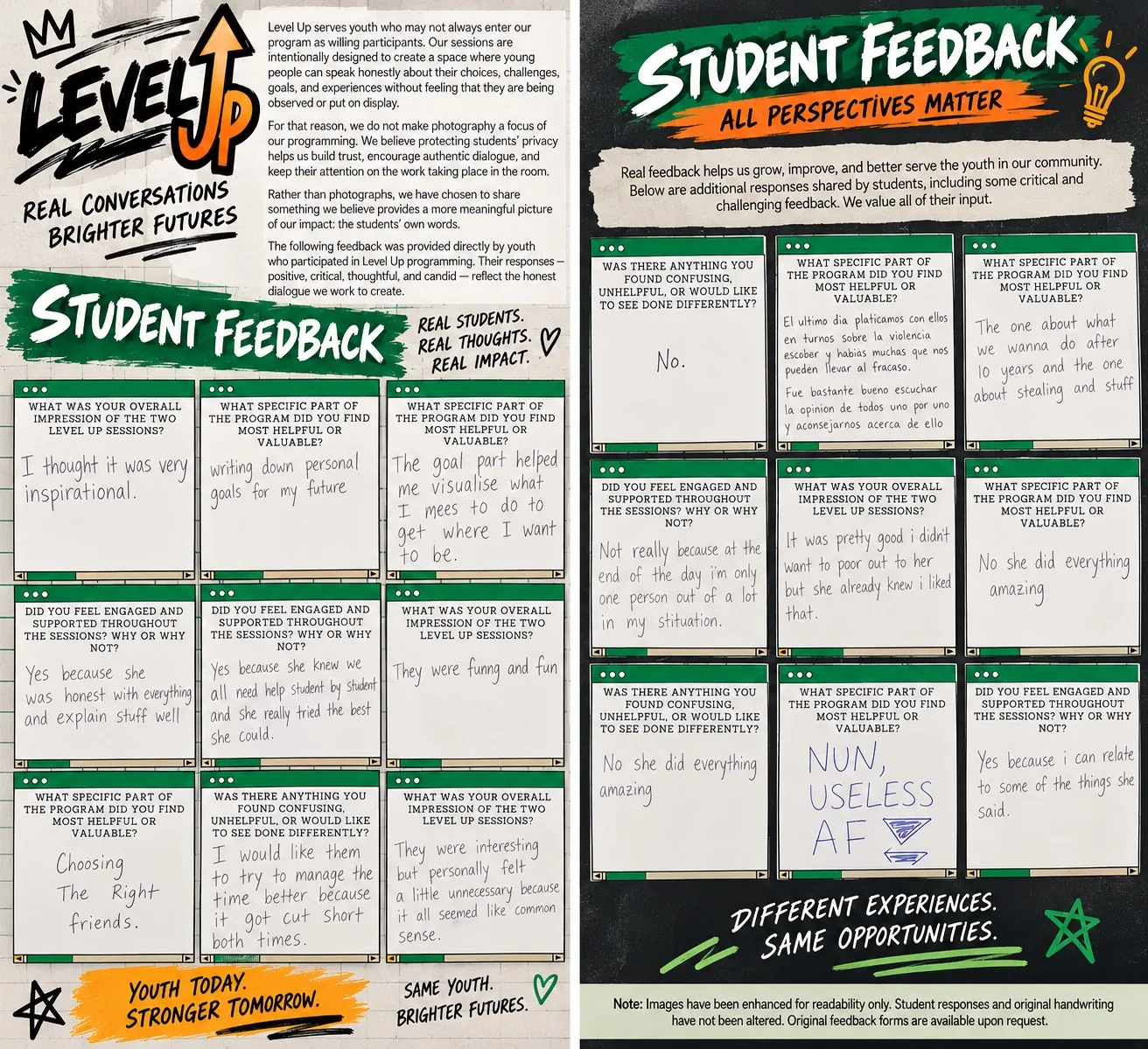
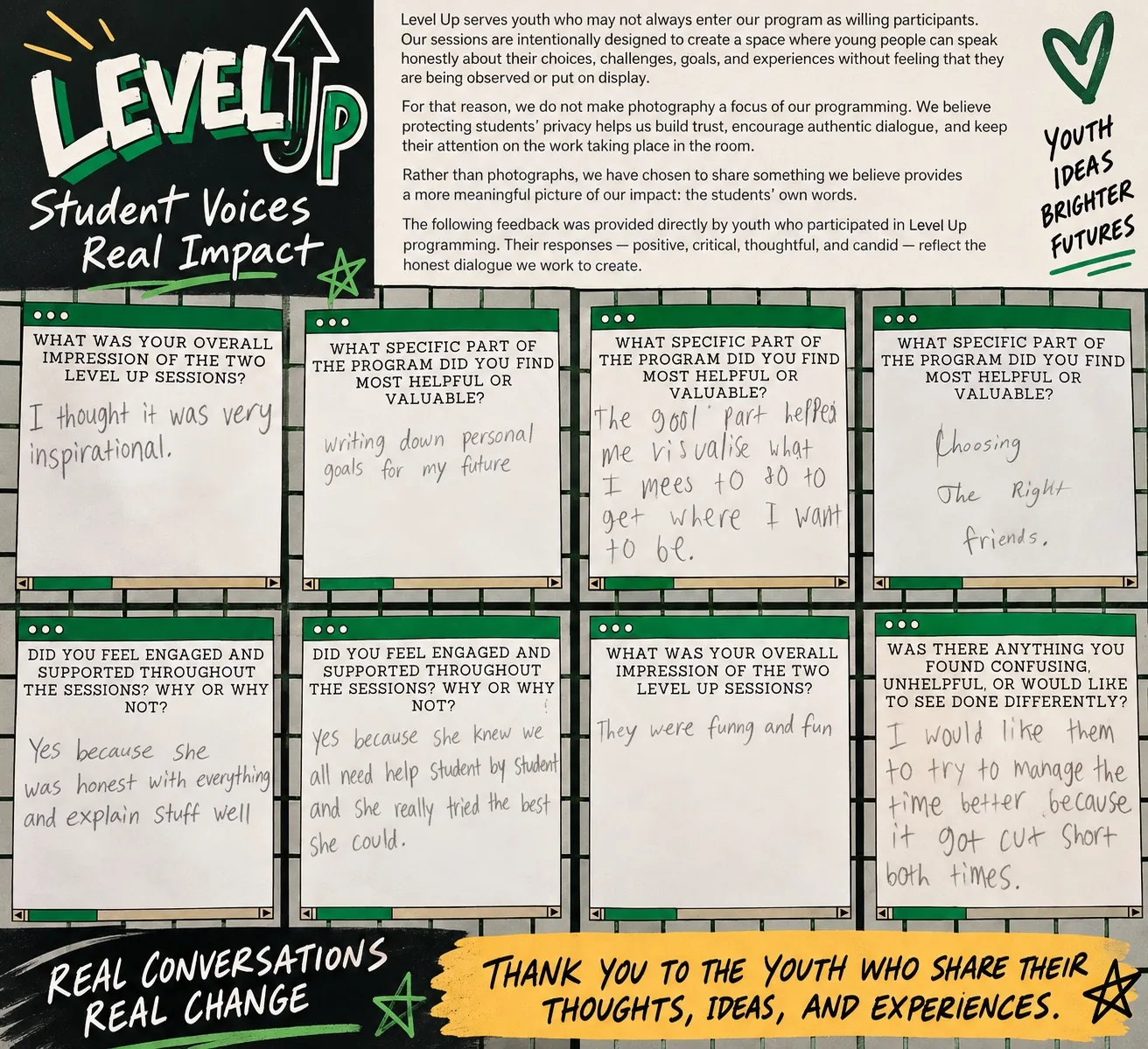
We do not photograph young people to prove our work. We publish what they wrote, in their own handwriting, including the responses that were not kind to us.
Every response collected from these sessions is published here, in the student's own handwriting, whether it was complimentary or not.
This is the feedback from a specific set of sessions. It is not a measure of the program's overall outcomes, and we do not present it as one.
The feedback wall
Different perspectives help us grow.
Tap any card to enlarge it and read the response. Filter to see only the critical ones if that is what you came for.
Images may be enhanced for readability only. Student responses and original handwriting have not been altered. Original feedback forms are available upon request.
What we asked
Four questions. No leading.
Feedback forms asked open questions and left room for an honest answer, including one that invites criticism directly.
- What was your overall impression of the two Level Up sessions?
- What specific part of the program did you find most helpful or valuable?
- Did you feel engaged and supported throughout the sessions? Why or why not?
- Was there anything you found confusing, unhelpful, or would like to see done differently?
Not every answer is perfect. That's OK. It's real.
If a feedback wall only shows compliments, it is marketing. We would rather show a wall you can actually trust, which means leaving in the student who wrote that the sessions felt unnecessary, and the one who wrote two words we would not have chosen.
Why there are no photographs
Privacy is what makes the honesty possible.
Level Up serves youth who may not always enter the program as willing participants. Sessions are intentionally designed to create a space where young people can speak honestly about their choices, challenges, goals, and experiences without feeling that they are being observed or put on display.
For that reason, we do not make photography a focus of our programming. Protecting students’ privacy helps us build trust, encourage authentic dialogue, and keep attention on the work taking place in the room. Where an organization has its own media policy and consent process, we follow it, and we do not publish images that identify young people.
Rather than photographs, we have chosen to share something we believe gives a more meaningful picture of the work: the students’ own words.
The feedback shared here was provided directly by youth who took part in Level Up programming. Their responses, positive, critical, thoughtful, and candid, reflect the honest dialogue the program is built to create.
Privacy helps create trust.
Trust allows honest conversation.
Honest conversation creates space for growth.
Break the first link and the rest stops working. A young person who feels observed gives you the answer they think you want.
The original boards
How this feedback was first shared.
Level Up published these responses as feedback boards before this website existed. They are included here exactly as they were designed.
Want your students to have this conversation?
If your young people would benefit from an honest room and a workbook they keep, tell us about your setting.
- Principals, counselors, and campus support teams
- ISS and DAEP coordinators
- Juvenile justice and youth intervention staff
- Church and community youth leaders
- Funders and sponsors who want to make it possible